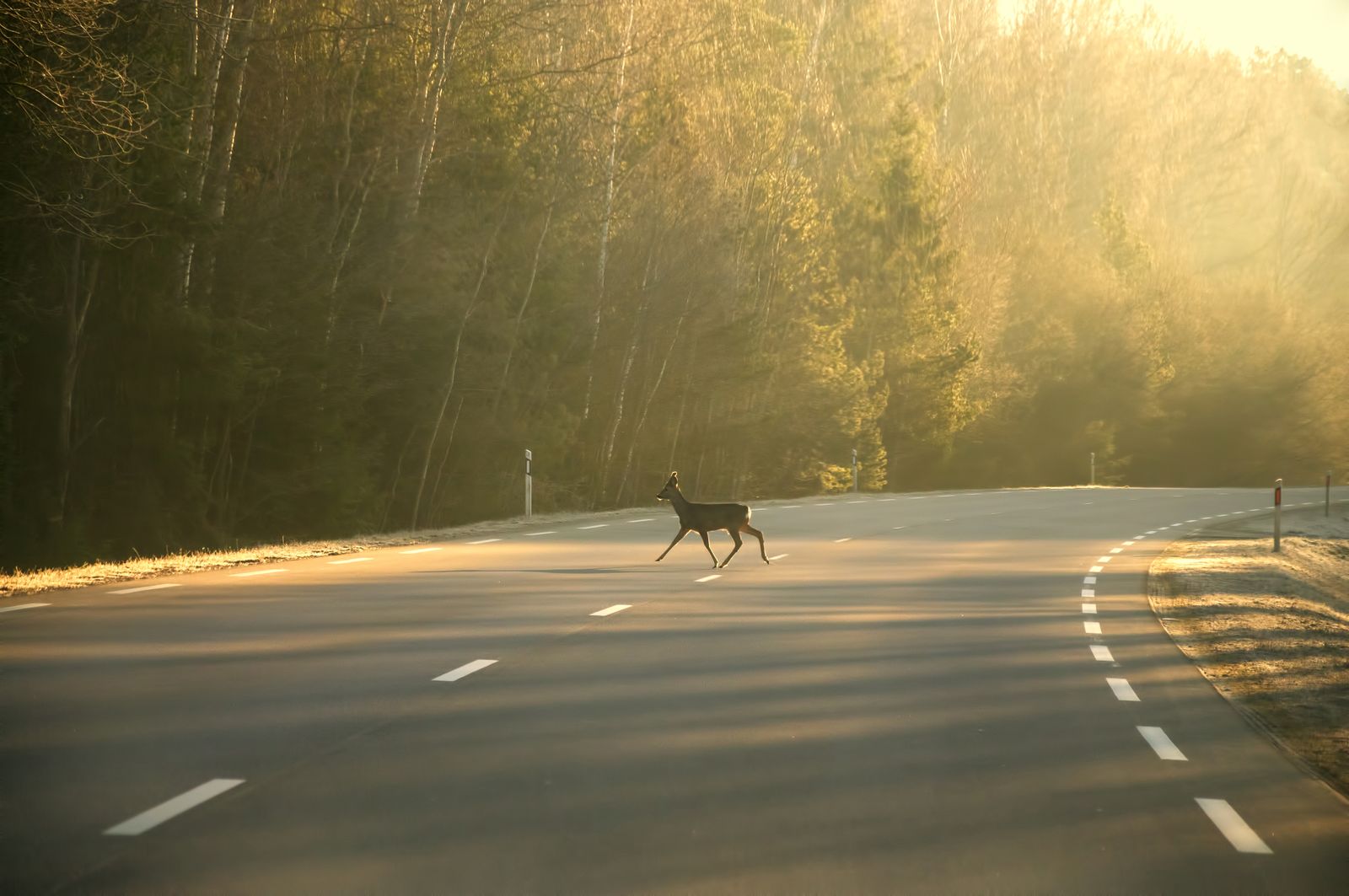
If you drive between Murray and Hazel after dark, or take Highway 94 out toward Kentucky Lake in November, you already know the drill. Eyes scanning the shoulders, foot ready to come off the gas, because somewhere along that tree line there is a deer deciding whether to cross.
Deer strikes are one of the most common auto claims we see in Calloway County and the surrounding area. They are also one of the most misunderstood, because the coverage that pays for them is not the one most people expect.
How big is the problem, really?
Nationwide, insurers handled an estimated 1.7 million animal-collision auto claims between July 2024 and June 2025, according to State Farm data reported by the Insurance Information Institute. That is not deer sightings or near misses. That is 1.7 million actual claims where an animal and a vehicle came together hard enough to file paperwork.
Western Kentucky contributes more than its share. Our service area, from Murray and Hazel up through Benton and Hardin, over to Mayfield and Paducah, and down into Paris and Puryear in Tennessee, is stitched together by rural two-lane roads that run right through prime deer habitat. Crop fields on one side, timber on the other, and a highway in between. That is a recipe for collisions, especially at dawn and dusk when deer move and drivers are commuting.
Why fall is the worst season
Deer are a year-round hazard, but the fall rut changes everything. From roughly October through December, bucks are chasing does with very little regard for traffic. Deer that spent all summer bedded down by mid-morning are suddenly crossing roads at all hours, often in groups. If one deer crosses in front of you, slow down anyway. There is a good chance a second one is right behind it.
Harvest season makes it worse. As row crops come out of the fields around Calloway, Marshall, and Graves counties, deer lose cover and food sources at the same time, which puts them on the move. Add earlier sunsets pushing evening commutes into full darkness, and you get the annual spike in bent hoods and cracked bumpers that every body shop in the region knows well.
The coverage surprise: comprehensive, not collision
Here is the part that catches people off guard. When you hit a deer, the claim is paid under your comprehensive coverage, not your collision coverage.
It sounds backwards. You collided with something, so it should be collision, right? Not in insurance terms. Collision coverage handles crashes with other vehicles and objects like guardrails, mailboxes, and ditches. Comprehensive coverage handles events largely outside your control: theft, hail, falling limbs, fire, and yes, animal strikes.
Why does this matter?
- If you carry liability only, a deer strike is entirely your bill. Kentucky’s minimum required coverage is 25/50/25 liability with PIP. None of that pays a dime toward your own vehicle when a deer totals it.
- Comprehensive claims are generally treated more kindly at renewal than at-fault collision claims, because you did not cause the deer to jump.
- Your comprehensive deductible is the number that matters. If your deductible is $1,000 and the repair is $1,400, you are covering most of it yourself. It is worth knowing that number before November, not after.
The swerve problem
Now the twist. If you swerve to avoid the deer and hit a tree, a fence, or the ditch instead, that is usually a collision claim, not comprehensive. You avoided the animal, so the animal is no longer the cause of loss in the eyes of the policy.
This is one reason law enforcement and safety experts give the same advice: brake firmly, stay in your lane, and do not swerve. Swerving at highway speed is how a fender-bender with a deer becomes a rollover, and it can also shift which coverage responds and how the claim is rated. Hitting the deer is almost never the worst outcome available to you.
If a strike does happen, pull off safely, turn on your flashers, and do not approach the animal. An injured deer is dangerous. Take photos, note the location, and call your agent. If the airbags deployed or the car is not drivable, call the police so there is a report.
Motorcyclists: a different level of risk
For everyone in a pickup or SUV, a deer strike is mostly a property claim. On a motorcycle, it is a medical event. A rider has no crumple zone, and an animal strike at speed frequently means going down.
If you ride the roads around Kentucky Lake or the Land Between the Lakes area, and plenty of our clients do, two things deserve a hard look. First, comprehensive coverage on the bike itself, for the same reasons as above. Second, and more important, the coverages that protect you: medical payments coverage, adequate uninsured and underinsured motorist protection, and a life insurance conversation if people depend on your income. Bike policies are not one-size-fits-all, and the cheap online quote often strips out exactly what a rider in deer country needs most.
What to review before rut season
You do not need to overhaul your whole policy. You need answers to four questions:
- Do I have comprehensive coverage on every vehicle I drive daily? Older paid-off vehicles are often the ones carrying liability only, and they are just as likely to meet a deer.
- What is my comprehensive deductible? Some carriers price a $500 deductible surprisingly close to a $1,000 one. Sometimes a small premium bump buys a lot of peace of mind.
- Do I have rental reimbursement? Deer season is busy season for body shops, and repairs can take weeks. Rental coverage costs little and keeps you moving.
- Does my policy fit how and where I actually drive? A commuter running the two-lanes to Murray State or Murray-Calloway County Hospital before sunrise has different exposure than someone driving three miles across town.
As an independent agency, we can put those questions to multiple carriers, including Erie and Progressive, and see who treats a western Kentucky driver best. We re-shop every renewal, so the answer can change as your situation does.
Talk it through before the leaves turn
A deer strike is stressful enough without finding out at the roadside that your policy was never built for it. If you are not sure whether you carry comprehensive, or what your deductible is, that is a five-minute conversation.
Call Boswell Insurance Agency in Murray at (270) 925-1524, or request a quote online. No pressure, no jargon. Just a straight answer about whether your coverage is ready for the roads we actually drive.